357 podcast intro (00:00)
If you've ever said to yourself that you can't market your business because you're an introvert, well, I'd like you to meet Jessica Wassick. Jess
is a self-described extreme introvert who hates small talk, lives in a small town outside of Pittsburgh, has built a pet photography business bringing in around two hundred thousand dollars a year. How? Well, we're gonna break that down. We're gonna talk about how she would start that business again if she was starting her business from scratch.
It is a conversation Heather Lahtinen had with her and I'm putting it here in the podcast because it is so good. Grab your notebook because you're gonna want to steal a few of these ideas. Stay tuned.
Nicole Begley (00:37)
I'm Nicole Begley, a zoological animal trainer turned pet and family photographer. Back in 2010, I embarked on my own adventure in photography, transforming a bootstrapping startup into a thriving six-figure business by 2012. Since then, my mission has been to empower photographers like you, sharing the knowledge and strategies that have helped me help thousands of photographers build their own profitable businesses. I believe that achieving $2,000 $3,000 sales is your fastest route to six-figure businesses.
that any technically proficient photographer can consistently hit four figure sales. And no matter if you want photography to be your full-time passion or a part-time pursuit, profitability is possible. If you're a portrait photographer aspiring to craft a business that aligns perfectly with the life you envision, then you're in exactly the right place. With over 350,000 downloads, welcome to the Freedom Focus Photography Podcast.
Ep 430 9 8 26 (01:36)
You are making around $200,000 per year in revenue. And I'm just curious if.
If everything disappeared, you know, like if your business for some reason blew up, or maybe you moved. So essentially, if you had to rebuild from zero, what is the first thing you would do? Make connections in my community with humans, other business owners, nonprofits, I would go everywhere. I would let everybody know what I did so that when they thought of me or they thought of dog photography, I'm the person that pops into their head.
Okay, so let's say you have 90 days, three months, and you've got to get this going very quickly. You're meeting people. Give me some specifics. And what else are you doing? When you're not meeting people and you're at your computer, what are you working on? When I'm not meeting people and I'm at my computer, I am building relationships with my past clients and continuing those relationships. I am But you let's say you don't have any past clients.
if I have no past clients, yeah. And I'm on a computer, which would not be the way I would approach this, I would follow every dog in Pittsburgh so that I am on their radar of like, who is this person? I would be connecting with every pet related business in my city. I would be looking at businesses that serve the people I want to work with, even if they're not pet focused, but my clients could potentially be there. I would just be making myself known. Meeting people.
meeting people all the time. Yes. Bottom line is you people grow a business. So you have to be out there meeting people in order to get clients. Like period. What's interesting about this is you said nothing about social media. No, not really. Um yeah it's nice that people can see your work on there, but if they don't know you exist to go follow you, then it's useless. It's just a bunch of pretty pictures sitting in a grid. Um you have to make yourself
available and known and the only way that's gonna happen is by physically appearing in front of them. How did you get your last like where did your last five clients come from? I'm curious. All the last five came from a new thing that I'm testing out, which is a breed of the month campaign. It's been really fun. Um it's something that I launched in July and I thought if this doesn't work, if I don't enjoy it, I'll just stop it in December and move on.
Um, I had seen it was working for some other people. And you know me, I like to take ideas and destroy them into something that works for myself. And I thought, how can I have this campaign still make it work for me? And that means make money and connect with some people who might want to work with me. They might have heard of me, but they need that little push to finally make that jump. So Brie of the Month is what I came up with, and all
Five have been through that and they've all been really good, strong clients. Okay, how tell me more about the structure of this campaign. I have seen it done many ways, and one of the ways I did not want to do it for myself was to offer truly anything for free. And I don't feel like that's bait and switchy. I just needed to ensure that the people coming in knew what the prize was and that I was gonna make something. So what the big winner wins is a complimentary session and five hundred dollars toward custom wall art or
Any artwork that they want. And then I'm pulling in a couple standouts that aren't my top winners, but that are still really good. They're also getting a free session and $250 in wall art credit. And then toying with bringing all of those big winners in for um kind of a charitable component and raising money for a rescue and having people vote on that with all of that going in. So that they're still getting a little extra something past just winning that breed of the month.
So they have to apply. How does this work? You you're posting, you're emailing, what are you doing? It's all application only. So I'm reading every single one. I've got my AI set up to help me choose because I've got a lot of past clients applying and I'm always gonna want to pick them, but I also want to bring in new people. So that's been helping. I read every application and basically I'm looking for people who aren't looking for free. They want to do this because it's the right time.
emotionally, logistically, financially, they want artwork. Um, I'm promoting it in my email, I'm promoting it on social media, past clients who don't even have the breed of the month are sharing. And it's just been a really good way to meet a lot of cool new dog owners that I haven't worked with. What are some what are some key indicators for you on the application that are leading you to believe that they're ready?
It's challenging because a lot of people can write a great story. And you can get sucked in with the emotions of like I love my dog so much. Everyone's gonna say that. But I'm looking for someone who's kind of telling me why this time in their life is the right time. Like maybe their dog is aging. Maybe they've been wanting to do this. Maybe they've been following me for a while. Um, maybe they've got a space that they're looking at every day and they don't know what to do with. I'm looking for a lot of that, um
I've actually found that people who sometimes are overly complimentary of me don't tend to be the best clients. Really? Um, yes. They tend to be the people I think who soften purchasing less by just filling me with compliments, which is great. Okay. I I don't I've just noticed this trend. I don't need that. So you can tell me how great my work is and all of this, but I want to hear more about what it means to you. Like why now?
And it's been um it's been an interesting differentiator between the people who really are invested in this on multiple levels and people who just think it's a great time and I want to get picked, so let's just fluff up Jess with some nice words, which I have to watch because I live for words of affirmation. It can be a it's a fine line to walk. my gosh, it totally works with me. If I had brides that wanted me to photograph their weddings, and let me give you an example. I did not like to do double headers Friday, Saturday. But if I had a bride that, you know, stroked my ego, like
Mather, we have to have you. You're the best. I would be like, okay. Okay, I'll do it. Yeah. So words of affirmation for me as well. Mm-hmm. Yeah. And you know, someone that's just like, this looks like it would be so much fun. I just love my dog so much. Okay. There there's not much meat past that. I'm really looking for someone who's going a little bit deeper. Okay. How many months have you been experimenting with this? So September would be my third month. I've done three so far. So you've had two months.
That you've executed. What's that average number of applications you're getting? Oh, well, the first month was interesting because I launched it at the beginning of the month and that was July, which fell right around the fourth of July weekend. And I toyed with do I launch it now? Do I wait? Are people on vacation? And I decided it's gonna launch at the beginning. So it's gonna be what it is if people see it. People saw it. I went with Labradors because there's a million and I only had three applicants, so it was like not good. And I didn't
Let it trip me up. I thought, let's see what happens month two. I went with pit bulls and that was huge. Like everyone's got a pit mix and that was crazy. Consistently I have booked 33%, which is like right on track with what I booked with just normal increase coming in. So it's working very well. Okay. And have you executed those sessions? Have you shot them yet? Had sales sessions? Okay, how did it go? Same as normal clients, same average sales, same products are selling. Really?
Okay, what do you attribute that to? Because I think some photographers conduct experiments like this, maybe not the same thing, and they end up saying to me, Well, it they weren't my ideal client, so they didn't spend the same amount. They just wanted the free thing or whatever was included. What it what is making this different for you? Uh the application's huge because that really clarifies a lot. Like I had someone write me this beautiful application, and then um on the part about like why is now the time.
went off on this tangent about everyone struggling financially. And I'm like, no, okay, thank you for your opinion, but not right now. It's not the right time for her. Um so the application has been huge, but also just treating them like every other client in that they applied for a reason. There's nothing um fake about this. I'm not bringing them in on a free session and then trying to upsell them. I'm very clear that this is credit toward artwork. And just getting them excited about that. The last question I asked on that application is
I'm excited to create artwork of my dog. And it's just a simple yes because I want to end with something really positive. So the application would be my number one go to, followed by just clear communication and what is expected of them, what I'm delivering, and what they can expect from me. So do you think that's the key, treating it like a regular session? I mean, where do you think photographers are maybe going wrong in this process? I'm seeing a lot of people think they have to give something away for free, or that if they're doing something.
If there's a charitable component that it has to benefit just the charity and not them. Because if they take anything from it, it's selfish, it's greedy, it's a trick. It's not. Like you can benefit your client and you can benefit yourself. And if you bring in a charitable component, they can benefit as well. So something you said earlier was you don't view it as a bait and switch and you approach it as a regular session. And I have heard some of our photographer friends say,
I feel like it's a bait and switch. And then they behave differently because that's their thought that's driving their actions. And they end up with a low to zero sale. Right. Yeah. If I tell them in the email, hey, this is where artwork starts and this is what you have toward that, they can do the math and kind of say, okay, I'm expected to spend a minimum of this. And if it's not the right time, it's not the right time. That's not a problem. But
If someone's coming in just thinking we're gonna do this for free and they're gonna walk away with thousands of stuff, mm-mm. It's it's not that. What is your sales average per session? You mentioned that they are paying your average. What is that? Typically it's around twenty five hundred. Mm-hmm. What's been your highest sale? I had one a couple years ago over thirteen thousand. uh How did you feel about that one? That's amazing.
That was an interesting sale. It was a past client. She spent over $10,000 her first session. Um, they don't live in Pittsburgh. They were actually living in Florida, they were on vacation. We did their ordering appointment over Zoom. Normally, if I have to do a Zoom appointment, I sit on the call and I send them their invoice and I say, Hey, your invoice is on the way. I'll let you know when your payment comes through. They're on vacation and I let them go because they're on vacation and they had somewhere to be.
They didn't pay the invoice right away. So part of me was like, my gosh, I just sent them a $13,000 invoice. They're gonna think this is insane. But other part of me was saying, Well, they already spent $10,000, it's only $3,000 more. Right. They're gonna pay it, they're busy. And they waited like four or five days. And I was in between that cycle of like, I'm really nervous. Are they gonna pay? Of course they are. No, they're not. Um, and then they paid. And the holdup was that they were just debating if they wanted to add more stuff on, which they ended up. Not really. See? But usually our brains go to
Some sort of negative, they're reconsidering that's too much money. This is insane, this is crazy. And assuming that it's not going to happen, but we would be wrong because it's the opposite. They actually wanted more. They wanted more and that was the delay of what did they want, what size, what frame. And I felt so stupid, just like, why didn't I just accept that of course they're gonna pay this? I caused myself days of going back and forth, of stressing myself out for nothing, and it all worked out fine.
It all worked out more than fine because a $13,000 sale on a pet portrait session is unbelievable. Like it's such a dream. It's so amazing. You said they were repeat clients? Mm-hmm. Yeah. Okay. That begs the question. How much of your um, I don't know if I want to say success or revenue comes from repeat clients and referrals versus brand new cold clients?
It's gone up this year. I would say last year it was about twenty to twenty five. This year it's closer to thirty, thirty-five. And I all attribute it to just staying in touch with them and staying on their radar and like giving them a reason to come back every year or every other year. And when they add new pets to bring them back in. Um I love my repeat clients and it's wonderful because I don't have to market as hard to them. It's just getting and it's so much easier than trying to find new people. So you and they'll find it for me. Right.
You obviously have an email list that you utilize. How often are you emailing? All the time. Um, twice a month on Fridays, a treat of the month at the beginning of the month, some stuff sprinkled in here and there, and then three more times for breed of the month stuff. So they're hearing from me a couple of times a week. And you have no thoughts about that, correct? No. If they want to unsubscribe, um, go ahead. I used to check because it used to throw me off, but I don't look anymore because they're either not my people and that's fine, and they don't want to read about cute dogs.
Um, or it doesn't mean anything. I've had past clients who unsubscribe and still book me. I don't know why she unsubscribe. I don't care. Like still on my email, I guess. So you're gonna miss some stuff that's going out only to past clients, but you're still hiring me, so that's okay. Right. I'll take it. Um I've actually had people in Elevate. Some of them have unsubscribed accidentally, and some of them have literally unsubscribed and stayed in Elevate. They love it. They just don't want the emails, I guess.
So I'm like, okay. Is that one of the first things you would tell photographers to do when establishing their business is start email list? Really early on, yeah. Because we don't know what happens with social media. We've seen it's not always the easiest to get on the algorithm. And I have found my clients don't really book me from social media. If they acquire inquire, it's fine. But um, they tend to be experienced chasers and not in it for what I'm here to bring them. So I'll put some attention there, but
I can get right in their inbox and they're not gonna miss me. So yeah, email list 100%. And have you ever had the thought that you're bothering people? No. I mean, I read emails and sometimes if I don't want to read them, I still like the person. I just delete it that day. Like I don't want to open that subject line. I don't care about that. I'm not gonna hate you. I'm not gonna unsubscribe. It's just no, I don't need to read it. It's okay. So you're a head coach inside of Elevate and you talk to a lot of photographers every month. And when someone says to you,
I don't want to bother people. How do you coach around that? I remind them that we don't see everything that somebody sends. We miss things. Our inbox, it gets buried. Social media doesn't show everybody stuff. So I never feel like I'm bothering them. And sometimes it's, you know, that fourth or fifth time that they see it that finally makes that click and they want to make that connection with you. So your your thoughts about it are di your thoughts are it, I mean, I don't want to put words in your mouth. You're serving.
And you're just giving them the opportunity you're inviting them into the opportunity, not bothering them. Yeah. very few of my emails are about book this session, buy this thing, do this with me. A lot of it is just a fun story, uh a blog post link that that might have value to them, a testimonial that gives them the confidence to know like I'm legitimate. Um, just good stuff that they can relate to. And I think that's actually what makes people respond is not selling, but just being a human that they're like, yeah, my dog does the same thing.
Just be a human. That's the key to everything. And don't overthink it. Don't let yourself get bogged down in a bunch of thoughts about you're bothering people or what this means or what they're thinking about your emails. You're just like connecting with people. And I think in your case, you're just reminding them that you exist. Entirely. Yeah. I I don't need them to buy something for me all the time, but I just need them to keep me in mind when they are ready to buy. And it's maybe a slower return. It might be a year or two after they first got on my list or worked with me.
It's okay. Like I have the patience. I'm just gonna wait until they're ready to come back. What who has been ki I don't know if you know this off the top of your head, your most repeat client and how many times have they used you? Uh, it's been about five. I have a lady who has um four or five dogs at a time usually, and she's come back about five times. That's amazing. And have any referrals come from her? Uh, not that I directly know of, but
No, I don't think no. No. It's possible though, maybe that somebody saw her photo. I can guarantee they've seen. Yes. But no one has directly said I've come to you from so and so. Yes. Okay. Take me back. What did you do before you were a pet photographer? How many years? How did you get started? Et cetera.
I have been in business this month will be ten years in a month. Congratulations. Which is um unreal because I never thought I'd be here. And that's what I think is so much fun about this whole thing is if you're open, like stuff can just flow to you. Um I started as a figure skating coach, which has seemingly no connection to this. But when I look at what I've learned from that, I'm like, no, actually I've learned a lot about thinking quick on my feet, timing, expression, um, resilience. Holy cow, resilience.
having a thick skin, like it's all worked into this business and where I am now. Um so I spent 31 years on the ice and then 2016 hooked up with you and um I think it was like it was March I talked to you. September I rolled into your office and I actually should have went back and looked but I remember working with you and like in within two days we had everything set up and we were not messing around. It was so fast and you know you pushed me just to go
Make money, go meet people with whether it's your friends, your family, whoever, go make a thousand dollars. And I failed epically, but I kept going. And I think that's the biggest thing is like I've everything I've done has never anticipated me coming here, but it it's all been building to produce this amazing business. So when we first met, we're both in the Pittsburgh area, we live about 15 minutes apart, and you came to my office and I let's say you sat down and I said to you, Jess, I
Promise you will be a six-figure photographer. In fact, you will probably at some point bring in $200,000 or more per year. What would you have said to me 10 years ago in that moment? I probably would have been speechless and thinking that you were crazy. Right. Because I had never I had never seen that amount of money when I came to you. Like I was making very little coaching. It was almost like side fun money. To make that amount, I thought, I'm gonna be so rich. Like this is unreal. But I would have questioned you like how?
How do know this? And you didn't, but it it happened. It did happen. There's actually no doubt in my mind that you would you would go on to become a six-figure photographer. Of course, I could never predict how well you would do, but there was something about you that told me she she's gonna figure this out. She's just you were determined to make this work. Do you happen to remember anything around that time that we talked about that was the most
impactful for you? man. Feels like it was so long ago, but like it wasn't. Um I just think you you believing in me made me believe in myself. I think that's what it was is when I can see that someone else sees something in me at that time that like I don't always see and having those people in your corner, I'm like, okay, well she says I can do it and I don't want to fail. Like how bad do I want this? I'm gonna just go for it because what do I have to lose? I have no business. I'm just
Right. Not losing clients and not losing money. Yeah, it was just having you believe in me and okay, well if you can see it, I guess it's there and I can go find it too. And my work was not good. It was fine. Like I could take a photo, but looking back, the editing was crazy, like things weren't always in focus, the composition was weird. But I didn't I always say I didn't know any better. I didn't know it was required to make a good business by traditional standards of success. I just was like, Okay, let's
Just try it and see what happens with this. And it's been really fun. It has been fun and it's been challenging. So, what would you tell your younger business self? Like 10 years in, what would you go back and tell her? Stubbornness is good in some ways and in other ways it's not. Um, I resisted getting support like through outsourcing because I thought I'm the only person who could ever do what I do. I don't need help. I like to do it. I have the time to do it.
As the years went on, I didn't want to have the time to do it. I wanted to spend time outside with my dogs, just not glued to a computer. So I resisted that. And it's good to listen to people who might have more experience than you in those areas, even if you don't like what they're telling you at the time. Eventually I came to accept it. And I'm like, why did I wait, I don't know, seven or eight years of my tent to actually implement this stuff? Now it's like ridiculous. So
It's good to be stubborn. It keeps you going. It keeps you motivated and you know, you know the good stuff's coming, but gotta be stubborn and persistent about the right stuff and not always your way. How do you know though? How do you know in those moments when the stubbornness is working for you versus against you? The stubbornness works for me when I want something bad enough that the struggle doesn't feel like it makes me want to give up. Whereas when I'm
When I'm having struggles and I'm still trying to have that uphill battle of like I can make it work, but it's just becoming more miserable for me. That's when I'm like, it's time to to pivot on something else. I guess that's the point is like your barometer, maybe your feelings tell you like if it's really negative, you can assume that it's working against you. But if it's driving you and it's building that resilience and determination.
Like I'm with you. I I'm stubborn as well in that I'm gonna figure this out. We're gonna grow this and we're gonna figure it out. And there's no other option. But that in your defense about the outsourcing, I do want to say that when you started and even in the last five years, you it wasn't as readily available as it is now to outsource, to get the help that you need in a way that's affordable or like the AI or anything that you what are you using AI wise in terms of your editing?
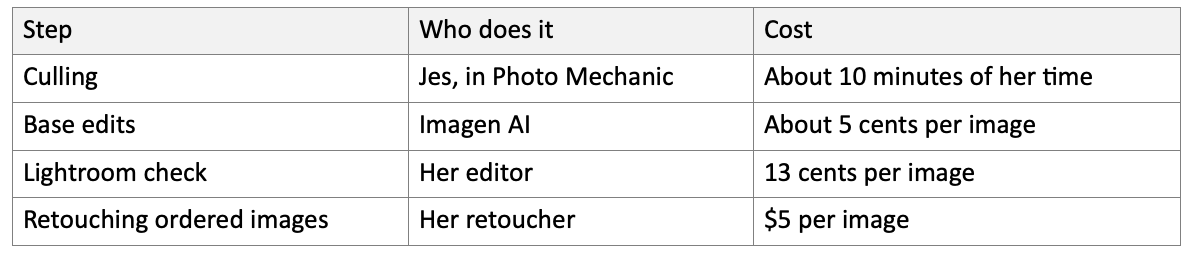
Um, I'm using Imagine AI just for like base edits in Lightroom. Um, that is it. And of course, like Photoshop stuff, but um I have a Lightroom editor who does put his human eyes on it and check everything over because it doesn't always come out perfect. and then I have a retoucher who goes over all of that and really fine-tunes the stuff that people purchased. it's not a ton, but it was it largely was uh editing that I didn't want to outsource. And it does nothing anybody can do. Right. Talk me through your workflow.
In terms of you shoot the session, you upload the images. What are you doing versus outsourcing and how much on average is it costing you per session? it's so affordable. So shoot the session. I'll come home. I will dump all of my images into photo mechanic because it's very quick. I can call a full session, I don't know, 10 minutes. Those images go into Lightroom. I export the catalog. That goes into Imagine AI. That gets sent off.
to my Lightroom editor and he does his little quick check on it that comes back. I glance over it, make any little tweaks I have to do, and then that's it. It's ready for uh ordering appointment just for them to have like a a high level view of how these will look. And then you you retouch or you have your retoucher work on the images they order. Right. So I think ImagineAI is like five cents an image. My Lightroom guy is 13 cents an image and he wanted to be paid less because he's a wedding
Retou wedding editor and not a pet. And I'm like, editing is editing. Like, okay, I'll pay you 10 cents and then we'll go up to your normal rate. And then um my retoucher's five dollars. So all in all, it's very affordable. Uh an album is probably what costs me the most with retouching, but I don't think I've ever paid more than $150 for a fully retouched session with an album. Give me the time frame from the shoot to when this is back in your hands, ready for sale session.
I was real upfront about this because I value a really quick turnaround time because if I delay that, I delay making money. And my clients don't want to sit around waiting on my workflow to meet up with their ordering appointment date. So I tell everybody that I want the Lightroom images back in about three days and then retouching needs to be within a week. And then those go out to the client. So it's very quick turnaround time. I will typically um get them back early, which is wonderful because I like that, but
Yeah, it's it's no more than a week and a half at most for everything. And total cost of all of that, that what is that costing you? uh six to seven dollars at most for the lightroom edits. And then anything after that for the ordering appointment gets the retouching, which does add a little bit more, but that comes out of product payment. Okay, so cost of of a session is uh shall we say minimal.
Yeah, the actual session fee is really low. It's only one ninety five. Um money. No, I'm at I'm at what you're paying per session. yeah, it's very, very minimal. And the amount of time I get back is huge. Because if I had to sit and do that, I wouldn't be paying myself thirteen cents an image to sit here and work. No, of course not. There's no way. I'd be losing money when I could be out meeting people. So what do you think the hesitation was going into this? Besides okay, let's establish this. We all think nobody can do it better than us. Of course. Everyone has that thought.
But beyond that one, why why would you have hesitated to do this? It was not cost. It was how do I do this? How do I find the right person? Where do they come from? How do I train them? How do I let go of control and give them the chance to shine in their own way, but still keep my little flair to the business on it? And I think that was the hardest part, but you actually know your business so well that training someone is easy. You just
Record, do a screen share, write down what you do. And once you've got that done, like you've got a library that you could train anybody with using those videos. so as long as you've got your process down, which you do because you've done it all these years, anybody can learn it. I wonder if some of the hesitation is just the like the mechanics of how. How do I structure this? How do I get this person? How do I set this up? So and then people, meaning me, are like, well, I'll just do it myself because I don't I don't understand how to make this happen. But
Would you say it was worth it? It was. And it's a a bit of work up front because you have to put all this together and record your process in real time, but it's done after that. It's a one time, you know, 15, 20 minute video per task if it's an involved one, and then it's living in Dropbox and I can always share it. What would you say to someone who maybe says, I can't afford that?
There are more affordable ways than hiring someone in person in the States. Um, everybody I work with is out of the country, either the Philippines and then my retouch is in Argentina. And it's a very fair wage that they're paid. Like we're not ripping them off. Of course, here it would be it would be ridiculous to pay that low, but it pays a very good amount to them and it can keep them, you know, supporting their family and their lifestyle. So you can find ways and you can start slow and you can build up when you need more and your business grows and you have the funds to support that, but it's
Way more affordable than you would ever think. When do you think someone should start to explore that in their business? Like it is it at what point? For me, it was when I was realizing how much time I was spending. So I always would say, like, keep track of how many hours you're spending on a session. And are you doing things you really don't want to be doing or need to be doing? And that's where I started out, like, well, I don't really want to sit and brighten up like fifty eyes on dogs.
How can I get rid of that off my plate? And it's kind of addicting once you realize, like, what else can I give people? Cause I have problems. Yeah. Yeah. If you're enjoying it, like, you know, sometimes I'll still do if I have just like three or four images, I'll do them myself because I feel like it and it's fun. But when I'm just dreading it, if there's a sense of dread, uh no, get rid of that. Somebody else loves to do that and give them the chance to. You can go outside. Yeah, right. And spend time in your life doing what you love or going out and meeting more people to get more sessions. Yeah.
Entirely. If I looked at how much time I was spending back on those early years of just like removing color cast on food, I'm like, this was ridiculous. my gosh. Yes. Nobody, none of my clients knew or cared. They wanted their images. Like they didn't care if I do it. They don't know. If they do know, they don't care that someone else touches it. They just want it to look nice. This begs the question because we always wish, once we figure this out, we always wish we had done it sooner, right? Like, my goodness, I should have done this sooner. Is there something else, either something like this?
Or a skill that you wish you had developed sooner. Oh, this was huge. Um, an overall skill, I think it was just letting go of control of every little thing has to be done the way I think it needs to be done. And it's hard because, like, for me, my business is just gets back so quick. Jess is great at this, Jess helped us with that. But letting other people step into that role has been.
It's been really good for me to learn because it's just made my business more enjoyable. Um I also think as an introvert, it was different to have to meet people and tell them what I do because I just want people to find me. I don't want to have to tell them where to find me or what I do. But it's actually really fun to talk to people about their dog and to tell them what I do and to hand out a little car and say, Yeah, like check it out and to make them feel good about it. So probably the other skill would just be um showing up as yourself and not worrying about
If someone thinks your dog photography business is silly. Like, of course it's silly. I play with dogs. It's fine. Just let them know you. Okay. I love that you brought this up because I want you to talk about like your personality. And you and Michelle Crandall had created a course inside of Elevate called How to Introvert as an entrepreneur. Because you live in a very small town. We do.
We live in a very small socioeconomically challenged area. And I would classify you these are your words, not mine. Extreme introvert. So when people say, Well, you don't understand, I live in a very small town. You don't understand people won't spend money. You don't understand I'm I'm really introverted. Tell us about yourself.
I do live in a small town and I don't market to these people. So we can rule these ones out, which means I have to leave this area and go meet people where I want to be working. I am very introverted. Um, not shy. I'm not shy. I'm just a person who wants to recharge on their own. I truly hate small talk. I don't care to talk to you in a grocery store line and hear you complain about something, but I want to talk to you about your dog and I want you to ask me about my dog purse. I love that. Um, I'm very direct.
Very direct. Um, and it's all been good because I think actually that's helped me lean into like, hey, I want to talk to that person about my business and here's what I do. Do you want do you want to learn more? It's okay. You don't have to be this outgoing person that, you know, runs up to everybody. When you find people that have dogs, things that you want to photograph, whatever, it's so easy to talk to them. And people love feeling special. I like to feel special.
I know I want to make someone else feel like I picked them out of this crowd of people with their really cute dog and just wanted to talk to them. I don't have to offer them a session. I don't have to make this great, you know, big deal, but just stepping out a little bit and making it easy for them to question what I do. Like you can tell I'm wearing my dog shirt. And I said to Mike, do I look like a person who, you know, dresses for the job they want today? And he just laughed at me. And it's okay. I know I'm a little ridiculous. I have to lean into it in this business. Everything about dog photography is ridiculous.
Right. So who cares? How do you keep this so clean and so simple in your mind? Because as you know, a lot of our friends don't want to talk to people. They don't want to bother them. They feel weird. They get embarrassed. They have all of these thoughts that prevent them from taking action. How in the world are you doing this? Um
Again, I think an advantage was I've always been self employed. So I've always had to figure out a way, like if I wanna make money for myself, it's on me. Like I don't have a steady paycheck. If I don't go meet people, they don't know I exist. If I don't exist, they don't book. If I don't book, I don't make money. And it all comes down to like you've do you want it bad enough? Go talk to that person. You just cannot sit here and hope that, yeah, Google might pop me up on someone's search that day. They don't even know that they need to be searching for me. Um
Yeah, like I'm a little weird. I'll do embarrassing stuff. It's fine. They're gonna forget about me. It's really it's fine. I'm very self deprecating at a session. There's nothing I'm gonna do or say that they're gonna look at me and be like, okay, well, she's crazy. Sure. Right, no kidding. You're you're fun and you're very easy to be around. And I think that's because you don't have a lot of garbage thoughts in your brain. Now I'm not saying that you don't. Right.
You of course you're a normal human that has normal anxiety-producing thoughts. And I think that's some people misunderstand you this way. Because you're able to keep this part of your business clean, it must mean you don't ever uh think or worry or have anxiety. Tell us how you manage, tell us about the overthinkatorium. Yeah, that that came to me at two in the morning when I'm laying there, you know, I wake up, take my dogs out, and then I'm trying to go back to sleep, but my brain won't turn off.
And I've come to accept it's never gonna turn off. I'm always gonna have an active brain. So I've had to learn to turn the volume down on it. So the overthinkatorium is the place where all these crazy thoughts go. Everything that I've ever thought of lives here. And it's okay. That can live there. Um I don't work the night shift. In my head it's these little minions that run around and they can deal with all the financial worries and the business worries and the booking worries and the, you know, what am I gonna do tomorrow worries.
It's fine. I wake up at six in the morning. The overthinkatorium is closed and I'm fine because I'm awake and I just go take action. It's it's my brain is always on. It's fine, but I don't have to listen to it. I'm not gonna work the night shift. I need to go to sleep to be a functioning person the next day to run a business. So what do you say to your brain? What are you saying at two AM? We're closed? We're closed. Like I don't work the night shift. This is not what the CEO does. This is for the little minions who are just starting out. You can go
run around there. Like I'm not paid enough to do this. I'm not being paid to sit and think about this at three in the morning. Right. I've also found if I and it's not just my business, if I see anybody doing something amazing, I make a note of it. And it doesn't even have to be in photography. It's possible. That person did this, it's possible. How can it be possible within my business? So I've had to think sometimes about that and it's a lot more fun. Like that's a place of evidence versus anxiety. Right. What would you encourage photographers to stop worrying about?
It like doesn't matter.
Oh. It doesn't matter where your bookings are coming from. It doesn't matter if they look like a qualified client at the time. It doesn't matter if you don't have as many inquiries as someone else. It doesn't matter if your photos are like beautiful. I can sell plenty of things. I sold a five-legged dog once. It just doesn't it doesn't matter. Your own thoughts don't even matter half the time because your clients are not worried about it or thinking about half the stuff that you are.
So actually there are no problems in business, truly. It's just some some things to figure out and some experiments to try. And how can we have this be fun instead of stressful and miserable? Yeah, just keep experimenting. And um, I've done plenty of experiments and some of them have failed or didn't work. And I just quietly let them fade away. Nobody's ever said, Hey, where did that one idea you mentioned go? Right, right. I don't know, it didn't work. So I never talked about it again.
I don't think people are paying that much attention to the things we are, but we're so up in our head, we're so up in our business. That's why it feels heavy, but it's it's not that big a deal. It's photography. Like I know it's fun. Like, let's just have fun. What would you tell the photographer currently making, say, I don't know, twenty-five or thirty K that wants to reach a hundred? Oh, go big. Like don't aim for twenty five to fifty thousand because if it's almost too doable, you kind of
back off the gas a little bit. I think shooting for something that's uh seems a little crazy will get your brain thinking in ways that are less obvious of how you can make this work. And it's gonna stretch you a bit into some different ideas and experiments. I think being around people who are doing what you need to be doing or want to be doing is really key because you're seeing the evidence of that all the time that it's possible. And as long as you don't get in your head about, well it happened for this person but not me, I I don't think
It could hurt you at all. Like it just put yourself in the proximity of those people. Well, talk to us about that, about the role education has played in your business. Yeah. Um, I got an LAV in 2020, like way before the pandemic hit. Um, and it was probably the one thing that kept me motivated when I couldn't do anything. You couldn't go shoot. Um, having people who encourage you, who understand, who hold you accountable is really important.
Every time I invest in more education, my um income jumps tremendously. My revenue shoots right up. And it can be scary because not all education is super low cost or free, but it has a a uh billion percent return. And it's something you have forever and you can pull off of and learn when you need to bring another idea in and implement something. Uh it will never be without education. Ever. You and I have the exact same approach to this.
Education and reading books. We both like to read incessantly. And we both invest a lot of money in education. I wonder why we do that because I think there's this belief that it my belief is that it will always pay off. Mm-hmm. It will. And even if it's been a course that I've purchased that I'm like, it's another phone script that I don't need.
Well, it taught I don't need a phone script because no one talks like that. Right. It might give me an idea of like bullet point some things to hit on, but even the things that don't land well with me, I still can get something out of. Even if it's, well, I don't like that type of teaching style. I'm gonna look for someone who does it this way. Um, and I've also learned to be careful to not chase every shiny object because when something's working, it's always gonna work for the person that tells you to buy my course to do this. Of course it does. Pull different
education sources into your business so that whatever you like from that you keep building and that's what's working for you. And you kind of then have your own little like education library. I love that idea. What would you say is the biggest your your biggest marketing success? Like the one thing if things were slow, you know that this works. What what is that? Right now I'd say breed of the month because it's just getting me in front of new people. Um
And it's it's been really just exciting to watch people come in who otherwise wouldn't have met me. So it's it's just new set of eyes on. Um charitable marketing is good as well. It's a slower return. I don't think I would lean toward that one for an immediate boost, but just something that gets your face in front of people and encourages them to like, all right, I'm gonna make this jump because hey, I've got a Labrador this month and sure, it sounds like a good time.
You know what's funny as you say this to me? What I'm thinking is that for you specifically, you experiment a lot with different you marketing ideas, strategies. And whatever you're experimenting with currently, you always say something similar, which is this is working great. uh This is working. This is working right now. And I could have talked to you six months ago and I could talk to you a year from now, and I would say, Jess, what's the experiment you're working on now?
You would tell me and then you'd be like, yeah, it's going great. You have this baseline, I don't know, what would you call this? Like you're going to figure it out, experiments work for you. Not not that they all do. Obviously there are things that don't work, but what what is your approach here that you think is setting you apart?
I don't want to say optimism because that sounds bad, but it is. It's like it's believing that it's fine. Everything is fine. Um, I'm an ignorance is bliss kind of person. Not that I don't believe there are struggles, because I've been through them and I see them, but I don't want to hear it. I don't want to listen to it. I don't want to be around the complaining. I'm just gonna tune it out, I'm gonna put my head down and I'm gonna keep chugging away. Cause a year ago book projects were working great and I enjoyed it. And then I thought, let's try something else. It's always gonna work because I I want it to and I enjoy it.
And if I don't enjoy it, um the experiment stops. But I'm just putting my head down and I'm gonna be an optimist in believing that it's it's gonna work because I don't have another option. Well, right. I I said that actually said that to myself this morning. I said, Heather, it's not an option for you. This is what we're doing. What's the next experiment? How do you maintain or how do you build resilience when things aren't working? Have you ever felt that way, like just really frustrated?
I've been frustrated mostly at myself, but yes, I have. So I look again to the evidence of other people that are are doing what I want. And even if it's not in photography, people are still spending. Um, you know, I'll look at different advertising campaigns, like I'll write ideas down even if I never implement them. Like Chick-fil-A had something, they were doing like a a deal a day. I wrote it down, I've never done it. But I just look outside my industry because it can feel small when in photography everyone's doing the same approach, they're all doing the same marketing campaigns.
If I look at different industries, I see new experiments to be tried and to kind of twist and make my own. So I'm just looking for evidence all the time that people are still happy. They're still happy to spend money. Like everything is still good, even though at times it feels like the world is falling apart. It's not Yeah, you're paying attention. You're paying attention to other industries and saying, like you alluded, you didn't allude to, you said, what are they doing? That's so interesting. How could I apply that?
What does that look like? I do the same thing and I do watch Chick-fil-A a lot because they usually have really good ideas of how they're approaching things. I just find their business model fascinating. Okay, I want to wrap this up, but I have a couple more questions. One is what do photographers believe they need to reach six figures that you know they don't need? You're like, oh, that's not it. I want to say more clients.
You can have fewer clients who are more aligned with what you want to be doing. So you can just make more, work a little bit less. You don't have to be killing yourself, which I've had to learn. I was someone who was never in true burnout, but I have made myself sick. And you don't have to work yourself into the ground to make six figures. It can be actually really really easy. Like I think I'm working less now than I ever have. And that was a lesson to learn for myself as someone who loves to work, but I also love to have a life now.
And I've learned that you can have both. really? Interesting. So this could be fun and easy. Is that what you're saying? Yeah. It doesn't have to be this like rhyme all the time. Yeah. It can be really good. What if it were fun and easy to make a hundred thousand dollars a year, just like when you first picked up your camera? It was fun and easy to learn how to take photos. Not not always easy. I mean, you have challenges, but
But you loved it. So you kept taking photos and then you turned it into a business. And it does not misery is like not required here. No, it's my own business. Why would I work for myself? And you know, if I want to be miserable, I'll go work for someone else. And I'm gonna still do a lot more work than I am doing on my own. So I'm not gonna build a business that I don't enjoy. What is the one thing you wish you could tell photographers? Like you coach a lot of photographers. What is the one thing you wish you could tell them that?
Maybe sometimes you can't or it isn't totally appropriate, but you're like, oh, if I could just tell them, what would it be?
I'd love to say stop complaining. Take just go figure it out. You're wasting so much time on dwelling on things that aren't working that you don't even see what could possibly work. So get off your computer, get out of all these chats that you're complaining about. Go outside your house and meet people. Stop making it hard. Like, do you enjoy making it hard? Is what I would love to say. Because it's just it's on you to fix.
Okay, I love that question. Do you enjoy making this hard? Are you enjoying your misery that you're creating for yourself? It sounds kind of cold, but that direct question, if somebody could receive it with the intent of like, I'm trying to help you, this does not have to be a slog. It could be super fun. And is it possible that you're making it harder than it needs to be?
And I think some people are because it's it's hard, but it's actually easier than going out and meeting someone or making an offer or trying something new that you probably is gonna fail because you've never done it before. It's just easier to say, Well, I don't know how. I it doesn't work, I don't even wanna try. You don't know that 'cause you've never tried it. Go try it. If it stinks, then move on. Like nobody's paying that close attention. No, nobody cares about your experiments but you and what you make them mean. Mm-hmm.
How do you you you've invited a lot of people to elevate. What do you tell them? How do you encourage them to join? Tell us. I always tell them that for me, the accountability is like unmatched. There's always someone there to support you. There's always someone there to answer a question or to keep you on track with what you're doing, um, to challenge you, which is good because sometimes we only see our point of view. And just like I keep track of my revenue every year and I see from 2025 when I started till or 2020 till now, it's
It's just jumped up every single year. And it's because I just continue to stay in there and learn and the value, like what you get, we don't get it anywhere for what we get in Elevate. I love that you are both a coach inside of Elevate. You coach and you teach. You host calls, you talk to people one on one, and you also still view yourself as a member, like you're still learning. Mm-hmm.
Yeah, and I think that's what's good is there's people of all levels. So you're not just coming in like wondering how to start your your sales tax stuff. You've got people at that level, you've got people in the mid range, and you've got people making, you know, even more than me. And it's incredible to learn from all of them because they all offer a different perspective and different viewpoints and opinions. It's it's a group like no other. Yeah, invaluable. Thank you. I love it as well. I love that you're part of it.
I love that you're there. You're so, so helpful. Okay. Last thing, where can people find you? My website is Bark and Goldphotography.com. I am on Instagram at Bark and Gold Photography and Facebook. And if you see me in Pittsburgh in dog clothes, it's me. So just come say hi. Everybody where um bark and gold comes from because people that aren't in Pittsburgh might not understand the reference.
Yep. We are a black and gold sports team city. So I wanted something that said what I do and where I do it. And people instantly are like, you're bark and gold. So they they know. Yeah, people in Pittsburgh absolutely understand when I say bark and gold photography, they're all like, I get it. Yeah. It's black and gold. Yeah. I thought that was brilliant when you came up with that. my goodness. How clever. And that was way before AI. So you did that all on your
I was a little nervous. I'm like, is it too cheesy? But like, that's who I am. So we're gonna run with it. And it's very memorable, and that's all I care about, is if it sticks in their mind. okay. Beautiful. Well said. Thank you so much for being here. I appreciate it. Thank you. I hope you caught some of the clues in this conversation with Jess because there are a lot of them. Experiment. Meet people. Stay visible. Keep learning. Stop assuming every thought in your brain is true. And when something doesn't work,
Figure out what you're going to do next. Again, Jess has been part of Elevate since the beginning. And today she's our head coach. She is one of several highly successful photographers inside the program who are not only building their own businesses, but sharing what they are learning along the way. If you want to grow a profitable photography business, one of the fastest ways to do that is to put yourself in proximity to people who are already creating the results that you want.
And that's what Elevate gives you. If you are ready to stop trying to figure everything out alone and start working alongside photographers like Jess, you can learn more and join us using the link in the show notes. I hope that you found this useful.